Mon - Sat 8.00 - 18.00 Sunday CLOSEDOur Address11 Wall St, New York
Tel: 530-666-6671 Pay With Square
07_13_26_2745316245_SBTB_560x292.jpg

July 25, 2026by admin

Tax problems can happen to even the most organized small business owners. A cash flow crunch, an unexpected tax notice, a missed filing deadline or a payroll tax oversight can be stressful — especially when penalties and interest begin to add up. Fortunately, businesses can get back on track by addressing tax issues promptly and strategically.

What should I do if I receive a tax notice?

If you or your business receives a tax notice from the IRS or a state agency, don’t ignore it. Start by reviewing the notice carefully. It may relate to:

  • A balance due,
  • A missing tax return,
  • A proposed tax adjustment,
  • A payroll tax deposit issue, or
  • A request for documentation.

Be aware that tax notices typically include response deadlines — and missing them can limit your options and lead to additional penalties and interest. Tax authorities may eventually pursue collection measures (such as liens or levies) on unpaid amounts. A lien is a legal claim against property, which can affect your ability to secure credit or complete financial transactions. A levy allows the tax agency to seize assets to satisfy the debt.

Before making a payment or sending a response, confirm that the notice is accurate. We can help you compare the notice with your business records, gather supporting documentation and prepare an appropriate response.

How far back can I file unfiled tax returns?

If you have unfiled tax returns, it’s important to address them as soon as possible. In many cases, you’ll need to file past-due returns before you can qualify for certain resolution options, such as a payment plan or settlement program.

How far back you need to file depends on your circumstances, the type of return involved and the tax agency’s requirements. There generally isn’t a simple time limit that makes an unfiled return “go away.”

For federal income taxes, the statute of limitations for the IRS to assess additional tax for a particular tax year generally starts only after a valid return is filed. It’s typically three years, but it’s six years if you understate your gross income by more than 25%. If you fail to file a return (or you file a false or fraudulent return), the IRS has an unlimited amount of time to assess tax for the tax year.

So filing past-due returns can help reduce the risk of penalties, interest and collection activity — as well as the risk that the taxing authority could create a “substitute for return” for you. (This is generally undesirable because the return likely will include your income but not all the deductions, credits and other tax breaks you may be eligible for.)

If you’re owed a refund, filing promptly is especially important because you may lose the ability to receive an otherwise valid refund if you wait too long. Federal income tax refunds and credits generally must be claimed by the later of three years from the date you filed the return or two years from the date you paid the tax.

What are my options if I owe back taxes?

Some business owners who owe tax can’t immediately pay the full balance due. If you owe back taxes, you may have several options depending on the amount owed, the type of tax involved and your financial situation. Ways to manage tax debt may include:

  • Making a payment,
  • Asking for a temporary delay in collection due to financial hardship,
  • Participating in a settlement program (see below), and
  • Setting up an installment agreement or payment plan.

An installment agreement or payment plan may give qualifying taxpayers extra breathing room to pay the balance over time. However, you must generally stay current with future tax filings and payments. Falling behind again can cause you to default on your payment plan and potentially lead to additional collection actions.

Can I settle my tax debt for less than the full amount owed?

Some tax agencies offer settlement programs that allow eligible taxpayers to settle tax debt for less than the full amount owed. For federal tax debt, the offer in compromise (OIC) program may be available in limited circumstances.

However, an OIC isn’t available to all taxpayers and may not be the best option in every situation. The IRS reviews income, expenses, asset equity and ability to pay when determining whether to approve an OIC request. Before applying, you’ll generally need to have all required tax returns filed. You also must be current with ongoing tax obligations, including estimated tax payments and federal tax deposits.

Can tax penalties be reduced or removed?

Penalty relief may be available in certain circumstances. Depending on the penalty and the facts involved, you may qualify for administrative relief, such as an automatic exemption from penalty, first-time penalty abatement or relief based on reasonable cause.

Reasonable cause may apply when you made a good-faith effort to meet your tax obligations but were unable to do so because of circumstances beyond your control, such as:

  • A serious illness,
  • A death in your immediate family,
  • A natural disaster, or
  • Loss of records.

Penalty abatement isn’t automatic. You must follow the instructions in the notice. You might need to call the IRS or submit a written request with a clear explanation and supporting documentation. Even if penalties are reduced, interest may still apply, so it’s advisable to respond as soon as possible.

Why are payroll tax-withholding problems so serious?

Payroll tax-withholding problems are among the most urgent tax issues small business owners can face. If you have employees on your payroll, you’re responsible for withholding federal income tax, state income tax (if applicable), Social Security tax and Medicare tax from their wages and remitting those amounts to the government. Tax agencies closely monitor these tax remittances because you’re withholding money on behalf of your employees and holding it in trust until you deposit it with the taxing authority.

In some cases, business owners or other responsible individuals may be held personally liable for unremitted taxes through the Trust Fund Recovery Penalty. The penalty can apply to individuals who are responsible for collecting, accounting for or depositing the taxes and who willfully fail to do so. If your business falls behind on these tax deposits, professional guidance is critical.

How can I avoid future tax problems?

For small business owners, preventing future tax issues starts with strong accounting systems, accurate bookkeeping and timely tax filings. You should also engage in proactive tax planning by reviewing financial reports regularly, setting aside funds for taxes, and making estimated income tax payments and depositing withheld taxes by the required deadlines.

If you’re facing tax resolution issues, contact us. We can help you understand your options, communicate with tax authorities and create a plan to keep your business moving full speed ahead.


07_06_26_2729090413_SBTB_560x292.jpg

July 25, 2026by admin

Small business owners must answer an important question: Should we use the cash or accrual accounting method for federal income tax purposes? Larger entities are required to use the accrual method. But certain small businesses can elect to use the cash method. You may want to consider this option if it will help lower your taxes. However, it’s not right (or even available) for every situation.

Does your business qualify for the cash method?

Under Internal Revenue Code Section 448(c), your business may be eligible for the cash accounting method if it had average annual gross receipts that don’t exceed a specific, inflation-adjusted threshold for the prior three-year period. For 2026, businesses with average annual gross receipts up to $32 million are eligible.

Some businesses may be eligible for cash accounting even if their gross receipts are above the threshold. Examples include S corporations, partnerships without C corporation partners, farming businesses and certain personal service corporations.

In addition, the Sec. 448(c) gross receipts test serves as the eligibility standard for several other tax provisions available to qualifying small businesses, such as:

  • Simplified inventory accounting,
  • An exemption from the uniform capitalization rules,
  • An exemption from the business interest deduction limit, and
  • The option to use the completed contract method (rather than the percentage-of-completion method) for certain long-term contracts.

When determining your business’s gross receipts, you may need to include those earned by certain related entities, such as those under common control. Special rules apply to organizations that have existed for less than three years. Also, tax shelters, including syndicates, don’t qualify for small business status, even if their gross receipts are below the threshold.

How do the methods differ?

The cash method often provides significant tax advantages. Because cash-basis businesses recognize income when received and deduct expenses when paid, they have greater control over the timing of income and deductions. For example, toward the end of the year, they can defer income by delaying invoices until the following tax year or shift deductions into the current year by accelerating expense payments.

In contrast, accrual-basis businesses recognize income when earned and deduct expenses when incurred, regardless of the timing of cash receipts or payments. Therefore, they have little flexibility to time the recognition of income or expenses for tax purposes.

The cash method also provides cash flow benefits. Because income is taxed in the year received, it helps ensure that a business has the funds needed to pay its tax bill.

However, for some businesses, the accrual method may be preferable. For instance, if your accrued income tends to be lower than your accrued expenses, the accrual method may result in a lower tax liability. Other potential advantages of the accrual method include the ability to deduct year-end bonuses paid within the first 2½ months of the following tax year and the option to defer taxes on certain advance payments.

Is it time for a change?

Even if your business would benefit from switching its accounting method, you should consider the administrative costs. Changing accounting methods for tax purposes may require IRS approval. And, if your business prepares its financial statements in accordance with U.S. Generally Accepted Accounting Principles, using the cash method for tax purposes would require you to maintain two sets of books (cash-basis tax records and accrual-basis financial reporting records).

Fortunately, you don’t have to make this decision by yourself. We can help determine the right method for your situation. Contact us to learn more.


06_29_26_337088279_SBTB_560x292.jpg

July 25, 2026by admin

Start-ups must choose a legal entity for their business activities. The type of entity you select affects how the business is taxed and who may be held personally liable for its debts and obligations, among other things.

Two popular options — assuming you’re going into business with one or more other people — are S corporations and multimember LLCs treated as partnerships for tax purposes. Both are pass-through entities, meaning tax items pass through to the individual owners and are reported on their personal federal income tax returns. And both offer liability protection. But there are subtle differences to factor into your decision. Here’s a closer look at the pros and cons of each.

Multimember LLCs

A multimember LLC essentially combines the legal advantages of corporations with the tax benefits of partnerships. If you operate your business as an LLC, your personal assets are generally protected from exposure to entity-related liabilities under applicable state law. In addition, all LLC members can participate in management without losing their liability protection (unlike partners in a limited partnership).

Members of this type of LLC are subject to the federal income tax rules for partners. That means your share of the LLC’s taxable income items, gains, losses, deductions and credits will pass through to you and be reported on your personal return. The LLC itself doesn’t owe federal income tax.

In addition to paying income taxes on your share of the LLC’s income, you may owe self-employment tax on that income. This includes Social Security tax at a rate of 12.4% on the first $184,500 of self-employment income in 2026 and Medicare tax of 2.9% on all self-employment income. However, half of your self-employment tax is deductible on your return.

It’s also important to note that this business structure isn’t available to all businesses. Certain types of professional practices may be prohibited from operating as LLCs under the laws of some states or applicable professional standards, such as state bar association rules.

S corporations

An S corporation is a special tax designation available to qualifying domestic corporations. Like a traditional C corporation, an S corporation shields its shareholders from personal liability for the corporation’s debts. At the same time, it provides many — though not all — of the tax benefits associated with partnerships.

If you structure your start-up as an S corporation, your share of the business’s taxable income items, gains, losses, deductions and credits will pass through to you and be reported on your personal return. The entity itself doesn’t owe federal income tax.

S corporations have one important advantage over LLCs treated as partnerships: Shareholder-employees aren’t required to pay self-employment tax on their shares of the profits, provided they receive “reasonable” compensation that’s subject to Social Security and Medicare taxes.

However, there are some downsides to consider. Notably, some partnership tax rules that apply to multimember LLCs and their members are significantly more favorable than the rules that apply to S corporations and their shareholders. Here are some examples:

  • LLC members receive additional tax basis for loss deduction purposes from entity-level liabilities, but S corporation shareholders receive additional tax basis only from loans they make to the corporation. This difference allows LLC members to deduct more losses.
  • When an LLC member purchases an interest from another member, the tax basis of the new member’s share of LLC assets can be stepped up. This lowers the new member’s tax obligation when LLC assets are sold or converted to cash.
  • LLCs and their members have greater flexibility to arrange tax-free transfers of assets (including cash) between themselves.

In addition, LLCs can make disproportionate allocations of taxable income, losses and other tax items among their members. In contrast, S corporations must allocate all pass-through tax items among the shareholders strictly in proportion to their stock ownership percentages.

Also, be aware that not all entities are eligible to make a Subchapter S election. S corporations must comply with strict requirements that limit the number and types of shareholders, prohibit complex capital structures, and impose other restrictions (such as transfers to ineligible shareholders).

Make a tax-smart choice

Choosing your business entity requires careful consideration. Taxes play a pivotal role in this decision. Electing S corporation status or forming an LLC that’s treated as a partnership for tax purposes can provide tax advantages, but only if you structure the entity correctly. Before making your decision, consult with us. We can work with you and your legal advisors to determine the optimal setup for your situation.


06_22_26_2495358801_SBTB_560x292.jpg

July 25, 2026by admin

Do you operate a side gig in addition to your regular day job? Whether you’ve turned a love for crafting into an online store or you play the guitar at a local venue, you’ll need to report the income from your sideline activity on your tax return. But can you deduct the related expenses? The answer depends on whether the IRS classifies your activity as a business or a hobby. Let’s take a closer look.

Why the distinction matters

If your activity incurs significant expenses — or even losses in some years — how the IRS classifies it can have a major impact on your taxes. For-profit businesses can deduct “ordinary and necessary” business expenses.

So, if you operate an unincorporated for-profit business activity that generates a net tax loss for the year (deductible expenses in excess of revenue), you can use the loss to offset income from other sources, such as salary and self-employment income, subject to annual limits. In 2026, the limit is $256,000 ($512,000 for married couples filing jointly). You can carry any excess losses forward to later tax years.

Conversely, hobbies receive less favorable treatment. Before 2018, hobby expenses could be claimed as miscellaneous itemized deductions subject to the 2% of adjusted gross income floor. Recent tax law changes permanently repealed itemized deductions for miscellaneous business expenses. So you generally can’t deduct hobby-related expenses for federal income tax purposes — even though you’re still required to report 100% of hobby-related income.

Potential safe harbors for profitable ventures

If you can show a profit motive for your sideline activity, the IRS will classify it as a for-profit business, and you can generally write off related expenses as the cost of doing business. Two safe harbors create a presumption that an activity is engaged in for profit:

  1. Your activity produces positive taxable income (revenues in excess of deductions) for at least three out of every five years.
  2. You’re engaged in a horse racing, breeding, training or showing activity, and your activity produces positive taxable income in at least two out of every seven years.

Proactive tax planning can help you qualify for these safe harbors — and earn the right to deduct your losses in unprofitable years.

Factors that demonstrate a profit motive

If you aren’t eligible for one of the safe harbors but can demonstrate an honest intent to make a profit, you may still be able to treat your side gig as a for-profit business. After all, many start-ups take years to become profitable. Questions the IRS considers when determining whether your activity is a business or a hobby include:

  • Do you carry on the activity in a business-like manner?
  • Does the time and effort put into the activity indicate an intention to make a profit?
  • Do you depend on income from the activity?
  • If there are losses, did they occur due to circumstances beyond your control or in the start-up phase of the business?
  • Have you changed methods of operation to improve profitability?
  • Do you (or your advisors) have the knowledge needed to carry on the activity as a successful business?
  • Have you made a profit in similar activities in the past?
  • Does the activity make a profit in some years?
  • Do you expect to make a profit in the future from the appreciation of assets used in the activity?

The degree of personal pleasure you derive from the activity is also a factor. For example, most people would say that woodworking is more fun than working in a high-stress executive position — so the IRS is far more likely to classify the former is a hobby if you start claiming recurring losses on your tax returns.

Year-by-year determination

The IRS tests each year separately when determining whether an activity is a for-profit business or a hobby. So what once was considered a hobby can become a business — and vice versa. However, you generally bear the burden of proving your profit motive each year.

For example, you might be able to persuade the IRS that you’ve established a profit motive by keeping more detailed records, advertising and devoting more time to your side gig. It also helps to report profits for a few years, rather than just recurring losses. In fact, a pattern of losses over multiple years can sometimes trigger IRS scrutiny of whether an existing business is operating with a profit motive.

Start planning now

If you have a side business that isn’t yet profitable, we can evaluate your situation and offer suggestions to help improve your odds of business tax treatment. But don’t wait until year end — many factors the IRS considers when evaluating your profit motive require proactive planning throughout the year. We can help strengthen your position in case the IRS questions your deductions. Contact us to learn more.


ChatGPT-Image-Jun-20-2026-04_56_31-PM-1280x640.png

July 1, 2026by admin
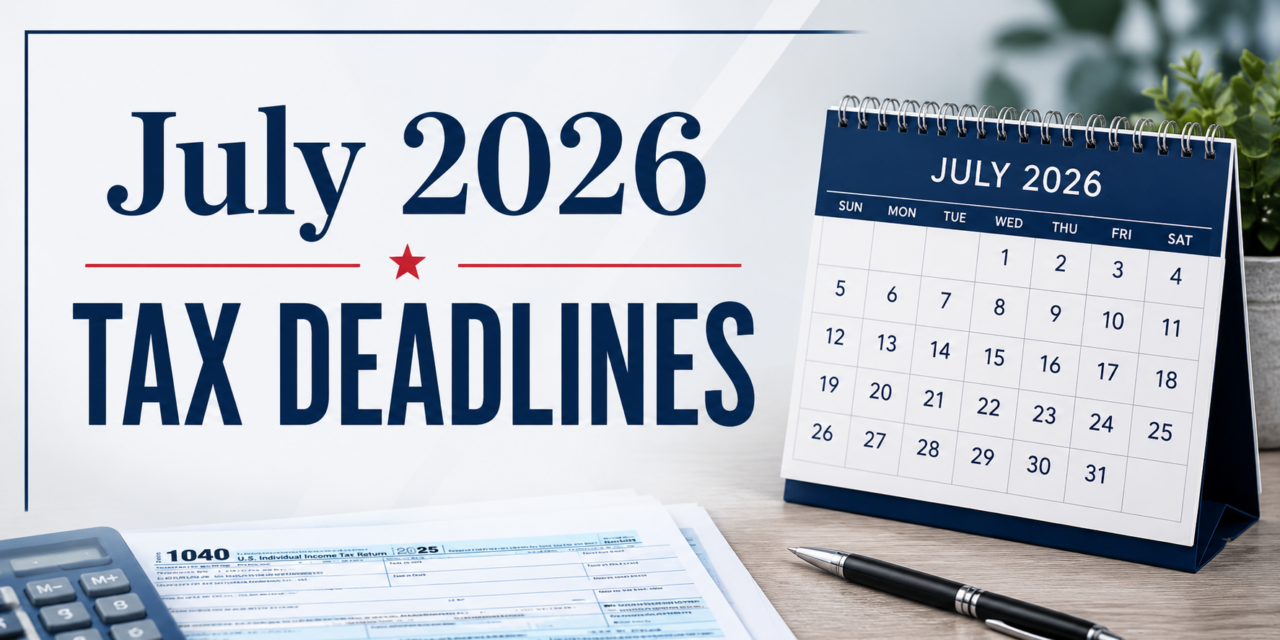
  • July 10: Employees who received $20 or more in cash and charge tips during June 2026 must report them to their employers (using IRS Form 4070). 
  • July 15: Employers must deposit June 2026 payroll taxes (withheld income tax and both employer and employee Social Security and Medicare taxes) if the monthly deposit rule applies. 
  • July 31: File the second-quarter Form 941 to report and reconcile withheld income and FICA taxes. 
  • July 31: File IRS Form 720 for the second quarter to report and pay federal excise taxes.
  • July 31: File IRS Form 5500 or 5500-SF to report employee benefit plan information for the 2025 calendar year (if you run a retirement or benefit plan). 
  • July 31: File IRS Form 2290 and pay the Heavy Highway Vehicle Use Tax for vehicles first used in July.