Mon - Sat 8.00 - 18.00 Sunday CLOSEDOur Address11 Wall St, New York
Tel: 530-666-6671
1031exchange.jpg

February 1, 2022by admin

Do you want to sell commercial or investment real estate that has appreciated significantly? One way to defer a tax bill on the gain is with a Section 1031 “like-kind” exchange where you exchange the property rather than sell it. With real estate prices up in some markets (and higher resulting tax bills), the like-kind exchange strategy may be attractive.

A like-kind exchange is any exchange of real property held for investment or for productive use in your trade or business (relinquished property) for like-kind investment, trade or business real property (replacement property).

For these purposes, like-kind is broadly defined, and most real property is considered to be like-kind with other real property. However, neither the relinquished property nor the replacement property can be real property held primarily for sale.

Important change

Under the Tax Cuts and Jobs Act, tax-deferred Section 1031 treatment is no longer allowed for exchanges of personal property — such as equipment and certain personal property building components — that are completed after December 31, 2017.

If you’re unsure if the property involved in your exchange is eligible for like-kind treatment, please contact us to discuss the matter.

Assuming the exchange qualifies, here’s how the tax rules work. If it’s a straight asset-for-asset exchange, you won’t have to recognize any gain from the exchange. You’ll take the same “basis” (your cost for tax purposes) in the replacement property that you had in the relinquished property. Even if you don’t have to recognize any gain on the exchange, you still must report it on Form 8824, “Like-Kind Exchanges.”

Frequently, however, the properties aren’t equal in value, so some cash or other property is tossed into the deal. This cash or other property is known as “boot.” If boot is involved, you’ll have to recognize your gain, but only up to the amount of boot you receive in the exchange. In these situations, the basis you get in the like-kind replacement property you receive is equal to the basis you had in the relinquished property you gave up reduced by the amount of boot you received but increased by the amount of any gain recognized.

An example to illustrate

Let’s say you exchange land (business property) with a basis of $100,000 for a building (business property) valued at $120,000 plus $15,000 in cash. Your realized gain on the exchange is $35,000: You received $135,000 in value for an asset with a basis of $100,000. However, since it’s a like-kind exchange, you only have to recognize $15,000 of your gain. That’s the amount of cash (boot) you received. Your basis in your new building (the replacement property) will be $100,000: your original basis in the relinquished property you gave up ($100,000) plus the $15,000 gain recognized, minus the $15,000 boot received.

Note that no matter how much boot is received, you’ll never recognize more than your actual (“realized”) gain on the exchange.

If the property you’re exchanging is subject to debt from which you’re being relieved, the amount of the debt is treated as boot. The theory is that if someone takes over your debt, it’s equivalent to the person giving you cash. Of course, if the replacement property is also subject to debt, then you’re only treated as receiving boot to the extent of your “net debt relief” (the amount by which the debt you become free of exceeds the debt you pick up).

Great tax-deferral vehicle

Like-kind exchanges can be a great tax-deferred way to dispose of investment, trade or business real property. Contact us if you have questions or would like to discuss the strategy further.



fraud.jpg

February 1, 2022by admin

Many employees — from retail workers to sales staffers involved in complex business-to-business transactions — receive part of their compensation from sales-related commissions. To attract and retain top talent, some companies even allow employees to earn unlimited commissions.

Unfortunately, some commission-compensated employees may be tempted to abuse this system by falsifying sales or rates. Fraud methods vary depending on an unethical salesperson’s employer and role. But companies need to be aware of the possibility of commission fraud and take steps to prevent it.

3 forms

Generally, commission fraud takes one of three forms:

  1. Invention of sales. A retail employee enters a fake purchase at the point of sale (POS) to generate a commission. Or an employee involved in selling business services creates a fraudulent sales contract.
  2. Overstatement of sales. Here, a worker alters internal sales reports or invoices or inflates sales captured via the company’s POS.
  3. Inflation of commission rates. An employee changes a company’s commission records to reflect a higher pay rate. Employees who don’t have access to such records might collude with someone who does (such as an accounting staffer) to alter compensation rates.

More sophisticated schemes can involve collusion with customers and other outside parties.

Data-driven approach to detection

Regardless of the method used to commit commission fraud, these schemes create data and a document trail your business can use to detect abuse. For example, to uncover commission fraud in progress, you should regularly analyze commission expenses relative to your company’s sales. After accounting for timing differences, the volume of commission payments should correlate to sales revenue.

Also pay close attention to the total commission paid to each employee. Focus on outliers whose commission levels are significantly higher and analyze sales activity and the associated commission rates to ensure consistency. By creating benchmarks — based on commission sales by employee type, location and seniority — you can more easily detect fraud in subsequent periods. Randomly sampling sales associated with commissions and ensuring relevant documentation exists for each payment can be effective, too. You can contact individual customers to verify sales transactions by disguising your calls as customer satisfaction checks.

Commission schemes sometimes require cooperation with other employees and customers, which usually leaves an email trail. Consistent with your company’s policies and procedures, monitor employee email communications for evidence of wrongdoing.

Prevention processes

There are other processes your business can follow to prevent fraud from occurring in the first place. For example:

Formalize policies prohibiting it. State the consequences (for instance, termination and criminal charges) of committing commission fraud in your employee handbook. Also routinely stress your company’s commitment to detecting commission fraud and explain that management will regularly scrutinize individual payments for signs of malfeasance.

Minimize the potential for record tampering. To help prevent salespeople from accessing accounting records, rotate accounting staff assigned to recording commission payments. Segregation of all accounting duties is important to help prevent other fraud schemes from flourishing in your organization.

Set realistic sales goals. Although some employees commit fraud for personal enrichment, others cheat to meet their employer’s overly aggressive sales targets. Periodically solicit feedback from sales staff about their ability to meet objectives and pay close attention when salespeople complain or leave your company. If you encounter excessive frustration in meeting targets, make them more achievable.

Making manipulation difficult

When structured and managed correctly, a commission program can boost employee compensation and morale — and add to your company’s bottom line. But schemes to manipulate a company’s compensation structure often are all too simple for shady salespeople to commit. To make fraud much harder to perpetrate, you may need to step up data analysis and revamp your internal controls.

Many companies don’t have the internal resources to conduct this type of analysis and don’t know how to fix controls that aren’t working. That’s where a CPA or forensic accounting specialist can help. Contact us.


mileage.jpg

February 1, 2022by admin

After two years of no increases, the optional standard mileage rate used to calculate the deductible cost of operating an automobile for business will be going up in 2022 by 2.5 cents per mile. The IRS recently announced that the cents-per-mile rate for the business use of a car, van, pickup or panel truck will be 58.5 cents (up from 56 cents for 2021).

The increased tax deduction partly reflects the price of gasoline. On December 21, 2021, the national average price of a gallon of regular gas was $3.29, compared with $2.22 a year earlier, according to AAA Gas Prices.

Don’t want to keep track of actual expenses? 

Businesses can generally deduct the actual expenses attributable to business use of vehicles. This includes gas, oil, tires, insurance, repairs, licenses and vehicle registration fees. In addition, you can claim a depreciation allowance for the vehicle. However, in many cases, certain limits apply to depreciation write-offs on vehicles that don’t apply to other types of business assets.

The cents-per-mile rate is beneficial if you don’t want to keep track of actual vehicle-related expenses. With this method, you don’t have to account for all your actual expenses. However, you still must record certain information, such as the mileage for each business trip, the date and the destination.

Using the cents-per-mile rate is also popular with businesses that reimburse employees for business use of their personal vehicles. These reimbursements can help attract and retain employees who drive their personal vehicles a great deal for business purposes. Why? Under current law, employees can’t deduct unreimbursed employee business expenses, such as business mileage, on their own income tax returns.

If you do use the cents-per-mile rate, keep in mind that you must comply with various rules. If you don’t comply, the reimbursements could be considered taxable wages to the employees.

How is the rate calculated? 

The business cents-per-mile rate is adjusted annually. It’s based on an annual study commissioned by the IRS about the fixed and variable costs of operating a vehicle, such as gas, maintenance, repair and depreciation. Occasionally, if there’s a substantial change in average gas prices, the IRS will change the cents-per-mile rate midyear.

When can the cents-per-mile method not be used?

There are some cases when you can’t use the cents-per-mile rate. It partly depends on how you’ve claimed deductions for the same vehicle in the past. In other situations, it depends on if the vehicle is new to your business this year or whether you want to take advantage of certain first-year depreciation tax breaks on it.

As you can see, there are many factors to consider in deciding whether to use the standard mileage rate to deduct vehicle expenses. We can help if you have questions about tracking and claiming such expenses in 2022 — or claiming 2021 expenses on your 2021 income tax return.


12_06_21_1210052781_SBTB_560x292.jpg

January 4, 2022by admin

If your business is successful and you do a lot of business travel, you may have considered buying a corporate aircraft. Of course, there are tax and non-tax implications for aircraft ownership. Let’s look at the basic tax rules.

Business travel only

In most cases, if your company buys a plane used only for business, the company can deduct its entire cost in the year that it’s placed into service. The cases in which the aircraft is ineligible for this immediate write-off are:

  • The few instances in which neither the 100% bonus depreciation rules nor the Section 179 small business expensing rules apply or
  • When the taxpayer has elected out of 100% bonus depreciation and hasn’t made the election to apply Sec. 179 expensing.

In those cases, the depreciation schedule is 20% of the cost for year 1, 32% for year 2, 19.2% for year 3, 11.52% for year 4, 11.52% for year 5 and 5.76% for year 6. Note that the bonus depreciation rate is scheduled to be phased down for property placed in service after 2022.

Interestingly, these “cost recovery” rules are more favorable than the rules for business autos. The business auto rules place annual caps on depreciation and, in the year an auto is placed in service, both depreciation and Sec. 179 expensing.

In the case of a business-travel-only aircraft, post-acquisition expenses aren’t treated differently than post-acquisition expenditures for other machinery and equipment. For example, routine maintenance and repair expenses are immediately deductible while amounts that improve or restore the aircraft must be capitalized and depreciated.

The only “catch” that distinguishes the tax treatment of an aircraft used 100% for business travel from the treatment of most other machinery and equipment is that company aircraft are one of the categories of business property that require more rigorous recordkeeping to prove the connection of uses and expenses to business purposes.

Business and personal travel

Personal travel won’t affect the depreciation results discussed above if the value of the travel is compensation income (and is reported and withheld upon as such) to a person that isn’t at least a 5% owner or a person “related” to the corporation. This means, for example, that personal travel by a non-share-holding employee won’t affect depreciation if the value of the travel is compensation to him or her and is reported and withheld upon. The depreciation results can be affected if the person for whom the value of the travel is compensation income is at least a 5% shareholder or a related person. But even in that case, the depreciation results won’t be affected if you comply with a generous “fail-safe” rule.

With one limitation, personal travel won’t affect the treatment of otherwise-deductible post-acquisition expenditures if the value of the travel is compensation income (and is reported and withheld upon). The limitation is that if the person for whom the value of the travel is to be treated as compensation income is at least a 10% owner, director, officer or a person related to the corporation, the amount of the deduction for otherwise-deductible costs allocable to the personal travel can’t exceed the travel value.

Moving forward

Other rules and limitations may apply. As you can see, even in the case of an aircraft used for business and personal travel, these rules aren’t onerous. But they do require careful recordkeeping and, when an aircraft is used for personal travel, compliance with reporting and withholding requirements. Contact us to learn more in your situation.


11_22_21_1075459908_SBTB_560x292.jpg

January 4, 2022by admin

The Employee Retention Credit (ERC) was a valuable tax credit that helped employers survive the COVID-19 pandemic. A new law has retroactively terminated it before it was scheduled to end. It now only applies through September 30, 2021 (rather than through December 31, 2021) — unless the employer is a “recovery startup business.”

The Infrastructure Investment and Jobs Act, which was signed by President Biden on November 15, doesn’t have many tax provisions but this one is important for some businesses.

If you anticipated receiving the ERC based on payroll taxes after September 30 and retained payroll taxes, consult with us to determine how and when to repay those taxes and address any other compliance issues.

The American Institute of Certified Public Accountants (AICPA) is asking Congress to direct the IRS to waive payroll tax penalties imposed as a result of the ERC sunsetting. Some employers may face penalties because they retained payroll taxes believing they would receive the credit. Affected businesses will need to pay back the payroll taxes they retained for wages paid after September 30, the AICPA explained. Those employers may also be subject to a 10% penalty for failure to deposit payroll taxes withheld from employees unless the IRS waives the penalties.

The IRS is expected to issue guidance to assist employers in handling any compliance issues.

Credit basics

The ERC was originally enacted in March of 2020 as part of the CARES Act. The goal was to encourage employers to retain employees during the pandemic. Later, Congress passed other laws to extend and modify the credit and make it apply to wages paid before January 1, 2022.

An eligible employer could claim the refundable credit against its share of Medicare taxes (1.45% rate) equal to 70% of the qualified wages paid to each employee (up to a limit of $10,000 of qualified wages per employee per calendar quarter) in the third and fourth calendar quarters of 2021.

For the third and fourth quarters of 2021, a recovery startup business is an employer eligible to claim the ERC. Under previous law, a recovery startup business was defined as a business that:

  • Began operating after February 15, 2020,
  • Had average annual gross receipts of less than $1 million, and
  • Didn’t meet the eligibility requirement, applicable to other employers, of having experienced a significant decline in gross receipts or having been subject to a full or partial suspension under a government order.

However, recovery startup businesses are subject to a maximum total credit of $50,000 per quarter for a maximum credit of $100,000 for 2021.

Retroactive termination

The ERC was retroactively terminated by the new law to apply only to wages paid before October 1, 2021, unless the employer is a recovery startup business. Therefore, for wages paid in the fourth quarter of 2021, other employers can’t claim the credit.

In terms of the availability of the ERC for recovery startup businesses in the fourth quarter, the new law also modifies the recovery startup business definition. Now, a recovery startup business is one that began operating after February 15, 2020, and has average annual gross receipts of less than $1 million. Other changes to recovery startup businesses may also apply.

What to do now?

If you have questions about how to proceed now to minimize penalties, contact us. We can explain the options.


wagebase.jpg

January 4, 2022by admin

The Social Security Administration recently announced that the wage base for computing Social Security tax will increase to $147,000 for 2022 (up from $142,800 for 2021). Wages and self-employment income above this threshold aren’t subject to Social Security tax.

Background information

The Federal Insurance Contributions Act (FICA) imposes two taxes on employers, employees and self-employed workers — one for Old Age, Survivors and Disability Insurance, which is commonly known as the Social Security tax, and the other for Hospital Insurance, which is commonly known as the Medicare tax.

There’s a maximum amount of compensation subject to the Social Security tax, but no maximum for Medicare tax. For 2022, the FICA tax rate for employers is 7.65% — 6.2% for Social Security and 1.45% for Medicare (the same as in 2021).

2022 updates

For 2022, an employee will pay:

  • 6.2% Social Security tax on the first $147,000 of wages (6.2% of $147,000 makes the maximum tax $9,114), plus
  • 1.45% Medicare tax on the first $200,000 of wages ($250,000 for joint returns; $125,000 for married taxpayers filing a separate return), plus
  • 2.35% Medicare tax (regular 1.45% Medicare tax plus 0.9% additional Medicare tax) on all wages in excess of $200,000 ($250,000 for joint returns; $125,000 for married taxpayers filing a separate return).

For 2022, the self-employment tax imposed on self-employed people is:

  • 12.4% OASDI on the first $147,000 of self-employment income, for a maximum tax of $18,228 (12.4% of $147,000); plus
  • 2.90% Medicare tax on the first $200,000 of self-employment income ($250,000 of combined self-employment income on a joint return, $125,000 on a return of a married individual filing separately), plus
  • 3.8% (2.90% regular Medicare tax plus 0.9% additional Medicare tax) on all self-employment income in excess of $200,000 ($250,000 of combined self-employment income on a joint return, $125,000 for married taxpayers filing a separate return).

More than one employer

What happens if an employee works for your business and has a second job? That employee would have taxes withheld from two different employers. Can the employee ask you to stop withholding Social Security tax once he or she reaches the wage base threshold? Unfortunately, no. Each employer must withhold Social Security taxes from the individual’s wages, even if the combined withholding exceeds the maximum amount that can be imposed for the year. Fortunately, the employee will get a credit on his or her tax return for any excess withheld.

We can help 

Contact us if you have questions about payroll tax filing or payments. We can help ensure you stay in compliance.


Q12022TaxDeadlines.jpg

January 4, 2022by admin

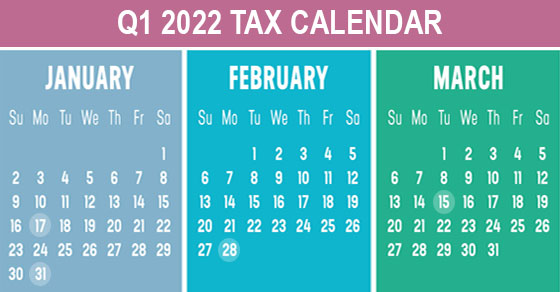
Here are some of the key tax-related deadlines affecting businesses and other employers during the first quarter of 2022. Keep in mind that this list isn’t all-inclusive, so there may be additional deadlines that apply to you. Contact us to ensure you’re meeting all applicable deadlines and to learn more about the filing requirements.

January 17 (The usual deadline of January 15 is a Saturday)

  • Pay the final installment of 2021 estimated tax.
  • Farmers and fishermen: Pay estimated tax for 2021.

January 31 

  • File 2021 Forms W-2, “Wage and Tax Statement,” with the Social Security Administration and provide copies to your employees.
  • Provide copies of 2021 Forms 1099-MISC, “Miscellaneous Income,” to recipients of income from your business where required.
  • File 2021 Forms 1099-MISC, reporting nonemployee compensation payments in Box 7, with the IRS.
  • File Form 940, “Employer’s Annual Federal Unemployment (FUTA) Tax Return,” for 2021. If your undeposited tax is $500 or less, you can either pay it with your return or deposit it. If it’s more than $500, you must deposit it. However, if you deposited the tax for the year in full and on time, you have until February 10 to file the return.
  • File Form 941, “Employer’s Quarterly Federal Tax Return,” to report Medicare, Social Security and income taxes withheld in the fourth quarter of 2021. If your tax liability is less than $2,500, you can pay it in full with a timely filed return. If you deposited the tax for the quarter in full and on time, you have until February 10 to file the return. (Employers that have an estimated annual employment tax liability of $1,000 or less may be eligible to file Form 944, “Employer’s Annual Federal Tax Return.”)
  • File Form 945, “Annual Return of Withheld Federal Income Tax,” for 2021 to report income tax withheld on all nonpayroll items, including backup withholding and withholding on accounts such as pensions, annuities and IRAs. If your tax liability is less than $2,500, you can pay it in full with a timely filed return. If you deposited the tax for the year in full and on time, you have until February 10 to file the return.

February 28

  • File 2021 Forms 1099-MISC with the IRS if: 1) they’re not required to be filed earlier and 2) you’re filing paper copies. (Otherwise, the filing deadline is March 31.)

March 15

  • If a calendar-year partnership or S corporation, file or extend your 2021 tax return and pay any tax due. If the return isn’t extended, this is also the last day to make 2021 contributions to pension and profit-sharing plans.

unnamed.jpg

January 2, 2022by admin

During January

All Employers – Give your employees their copies of Form W-2 for 2021 by January 31, 2022. If an employee agreed to receive Form W-2 electronically, post it on a website accessible to the employee and notify the employee of the posting.

January 3, 2022

Employers – Payment of deferred employer share of social security tax from 2020. If the employer deferred paying the employer share of social security tax or the railroad retirement tax equivalent in 2020, pay 50% of the deferred amount of the employer share of social security tax by January 3, 2022. The remaining 50% of the deferred amount of the employer share of social security tax is due by January 3, 2023. Any payments or deposits made before January 3, 2022, are first applied against the payment due by January 3, 2022, and then applied against the payment due on January 3, 2023.

Employers – Payment of deferred employee share of social security tax from 2020. If the employer deferred withholding and payment of the employee share of social security tax or the railroad retirement tax equivalent on certain employee wages and compensation between September 1, 2020, and December 31, 2020, it should have withheld and paid those taxes ratably from wages paid to the employee between January 1, 2021, and December 31, 2021. The employer is liable to pay the deferred taxes to the IRS and must do so before January 3, 2022.

January 10, 2022

Employees – who work for tips. If you received $20 or more in tips during December 2021, report them to your employer. You can use Form 4070.

January 18, 2022

Individuals – Make a payment of your estimated tax for 2021 if you did not pay your income tax for the year through withholding (or did not pay in enough tax that way). Use Form 1040-ES. This is the final installment date for 2021 estimated tax. However, you do not have to make this payment if you file your 2021 return (Form 1040 or Form 1040-SR) and pay any tax due by January 31, 2022.

Employers – Social Security, Medicare, and withheld income tax. If the monthly deposit rule applies, deposit the tax for payments in December 2021.

Employers – Nonpayroll Withholding. If the monthly deposit rule applies, deposit the tax for payments in December 2021.

Farmers and Fishermen – Pay your estimated tax for 2021 using Form 1040-ES. You have until April 18 (April 19 if you live in Maine or Massachusetts) to file your 2021 income tax return (Form 1040 or Form 1040-SR). If you do not pay your estimated tax by January 18, you must file your 2021 return and pay any tax due by March 1, 2022, to avoid an estimated tax penalty.

January 31, 2022

Individuals who must make estimated tax payments. If you did not pay your last installment of estimated tax by January 18, you may choose (but are not required) to file your income tax return (Form 1040 or Form 1040-SR) for 2021 by January 31. Filing your return and paying any tax due by January 31, 2022, prevents any penalty for late payment of the last installment. If you cannot file and pay your tax by January 31, file and pay your tax by April 18 (April 19 if you live in Maine or Massachusetts).

Employers – Give your employees their copies of Form W-2 for 2021. If an employee agreed to receive Form W-2 electronically, have it posted on a website and notify the employee of the posting. File Form W-3, Transmittal of Wage and Tax Statements, along with Copy A of all the Forms W-2 you issued for 2021.

Businesses – Give annual information statements to recipients of certain payments made during 2021. You can use the appropriate version of Form 1099 or other information return. Form 1099 can be issued electronically with the consent of the recipient.

Payers of nonemployee compensation – File Form 1099-NEC for nonemployee compensation paid in 2021.

Payers of Gambling Winnings – If you either paid reportable gambling winnings or withheld income tax from gambling winnings, give the winners their copies of Form W-2G.

Employers – Nonpayroll taxes. File Form 945 to report income tax withheld for 2021 on all nonpay-roll items, including backup withholding and withholding on pensions, annuities, IRAs, gambling winnings, and payments of Indian gaming profits to tribal members. Deposit or pay any undeposited tax under the accuracy of deposit rules. If your tax liability is less than $2,500, you can pay it in full with a timely filed return. If you deposited the tax for the year timely, properly, and in full, you have until February 10 to file the return.

Employers – Social Security, Medicare, and withheld income tax. File Form 941 for the fourth quarter of 2021. Deposit or pay any undepos-ited tax under the accuracy of deposit rules. If your tax liability is less than $2,500, you can pay it in full with a timely filed return. If you deposited the tax for the quarter timely, prop-erly, and in full, you have until February 10 to file the return.

Employers – Federal unemployment tax. File Form 940 for 2021. If your undeposited tax is $500 or less, you can either pay it with your return or deposit it. If it is more than $500, you must deposit it. However, if you deposited the tax for the year timely, properly, and in full, you have until February 10 to file the return.

Certain Small Employers – File Form 944 to report Social Security and Medicare taxes and withheld income tax for 2021. Deposit or pay any undeposited tax under the accuracy of deposit rules. If your tax liability is $2,500 or more for 2021 but less than $2,500 for the fourth quarter, deposit any undeposited tax or pay it in full with a timely filed return. If you deposited the tax for the year timely, prop-erly, and in full, you have until February 10 to file the return.

Farm Employers – File Form 943 to report Social Security and Medicare taxes and withheld income tax for 2021. Deposit or pay any undeposited tax under the accuracy of deposit rules. If your tax liability is less than $2,500, you can pay it in full with a timely filed return. If you deposited the tax for the year timely, properly, and in full, you have until February 10 to file the return.